
Last week, I wrote about an exercise called Bicep Curls on the Reformer and how its purpose isn't really about strengthening the biceps at all.
The movement of the arms is the action, but shoulder girdle stability is the skill being practiced.
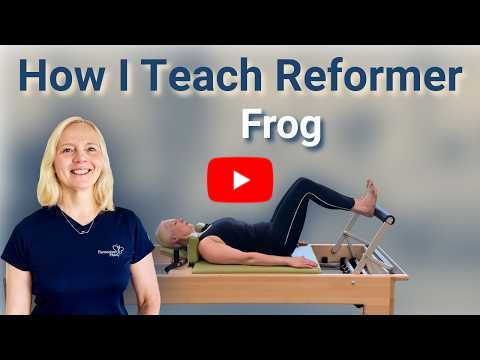
This week, let's look at Frog.
While teaching it to a beginner client, I often hear:
"This is such a great exercise. I really feel my quads. Can we increase the spring tension?"
It's a fair question—if the goal of Frog were to strengthen the quadriceps (the muscles at the front of the thighs).
Except that it isn't. 😊
In fact, this question highlights one of the biggest differences between learning exercises and learning movement skills.
When teaching Frog, I am not primarily looking at how hard the legs are working.
I am looking at the pelvis.
Can the legs bend and straighten without the pelvis tipping?
Can the legs move without the lower back arching?
Can the trunk remain organized while the legs are moving?
|
Clients immediately understand why stronger quadriceps might help them.
They don't immediately understand why learning to stabilize the pelvis might be important.
And honestly, that's reasonable.
The benefit of stronger quadriceps is obvious. The benefit of pelvic stability is less obvious.
Yet in my experience, some movement difficulties are not simply a matter of strength. They are also influenced by how well the body is organized and coordinated during movement.
People don't wake up in the morning saying:
"I wish I had better pelvic stability."
They wake up saying:
"My back hurts."
"I feel stiff."
"Walking is uncomfortable."
"I don't feel steady."
The challenge is helping people connect the skill being practiced to the activities they perform every day: walking, climbing stairs, getting in and out of a car, standing on one leg, getting up from the floor, carrying groceries.
These activities depend not only on the strength of major muscle groups, but also on how well the pelvis, spine, and legs work together.
I believe this is one of the reasons the Pilates method is sometimes misunderstood.
People see exercises and naturally focus on the muscles they feel working.
Teachers often focus on the skills being developed.
Because stronger muscles are valuable. But learning how to organize and stabilize the body is what allows strength to be used effectively.
The exercise itself is rarely the destination.It is simply the vehicle through which we practice skills that help us move through life with greater ease, efficiency, and confidence.
And the people who benefit the most are often those who remain curious enough to ask not just:
"What am I doing?" but: "What am I learning?"
To Your Health!
Joanna

Responses