
|
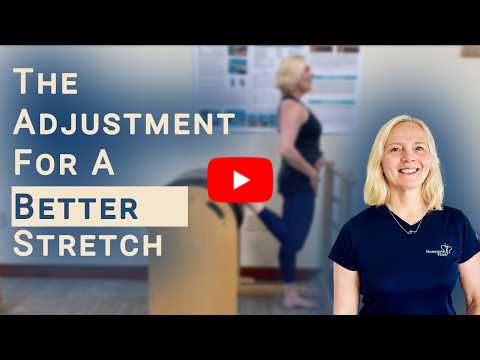
You most likely know this stretch. The “quad stretch”.
You grab your ankle, or your foot, your pant leg, you pull your foot towards your buttock, and you feel a stretch on the front of your thigh.
But this stretch can do so much more for your body if you know how to use all of what it offers.
Beside stretching your quadriceps, it can also stretch your hip flexors if you only make a small adjustment.
Hip flexors (a group of muscles at the front of the hip/upper thigh: iliopsoas, rectus femoris and sartorius) are responsible for lifting the knees and bending at the waist.
And if you lead a modern life, like most of us, you too experience tightness of the hip flexors due to prolonged sitting or overuse due to athletic activities. Such tightness, when not tended to, often causes low back or hip pain.
So what small adjustments do you need to make in order to feel the quad and hip flexors stretching?
You make an adjustment to the position of your pelvis.
It helps if you understand that one of the basic skills your body should have is pelvis mobility. You should be able to rock it back. You should be able to rock it forward. It doesn’t matter what the range of motion is. It can be minute for some; it can be bigger for others. But the mere fact that you are able to change the position of the pelvis—again, however small—is important.
Because if you rock your pelvis back, meaning you rock your hip bones back toward the spine, where the tailbone tilts up while the belly button moves closer to the spine, you are creating favorable circumstances for your hip flexors to stretch or elongate.
Otherwise, if you just grab your foot and pull on it but not adjust the position of your pelvis, you will feel a stretch in your quad, but the hip flexors will remain unchanged.
So rocking the pelvis back while you are holding your foot is the small adjustment you must perform in order to experience the stretch of both muscles.
But such stretch, being that it is a static stretch, only works up to a point.
Static stretching has its place, but it rarely creates lasting change on its own. Muscles respond best when they are warmed up, organized, and challenged through movement—not pulled on while cold and stationary.
This is where, when you practice Pilates, you experience first-hand the difference between static and dynamic stretching.
In the Pilates repertoire the hip flexors are lengthened during precise, thoughtfull, progressive movements.
Some of the examples of the exercises that directly and indirectly stretch and elongate the hip flexors.
-
Swan on Mat and all apparatus, and other spine extension exercises,
-
Knee Stretches, Short Box, Down Stretch on the Reformer
-
Leg Springs Series on Cadillac,
-
Sidekicks
-
The Spine Corrector Leg Series
-
And many more
Dynamic stretching does something static stretching cannot:
It builds length over time.
Rather than forcing a muscle to “give,” you create the conditions for it to reorganize. You warm it up. You support it. You put the body into positions where length is gained gradually and retained.
That’s an investment—in flexibility, but more importantly in what flexibility makes possible: A better functioning body for years to come.
So next time you are practicing Pilates, pay attention to the position of your pelvis in every exercise you are performing. Ask yourself: “Am I lengthening or shortening my hip flexors right now?”
If stretching has ever felt temporary, frustrating, or ineffective, this may be your missing link.
Watch the video. Practice the stretch. Notice the difference of how your body responds—not just today, but over time.
Getting to know how your body works and understanding the nuances of small adjustments, that’s the ultimate reason why you are practicing Classical Pilates.
For me Pilates Is A Way Of Life, and I hope it is for you as well.
To Your Health!
Joanna

Responses