
As you are reading this newsletter, you are probably sitting.
Before you read another sentence, don't change anything.
Just ask yourself one question:
How is my pelvis positioned right now?
Is there a noticeable arch in your lower back?
Does it feel like you are sitting more on your tailbone or closer to the tip of your pubic bone?
Place your hands on the front of your pelvis. Are your hip bones pointing more forward or more upward?
And perhaps most importantly...
Can you gently gather your lower abdominals, or does your belly simply push forward, making them difficult to access?
Here's a short video that explains what I mean.
|
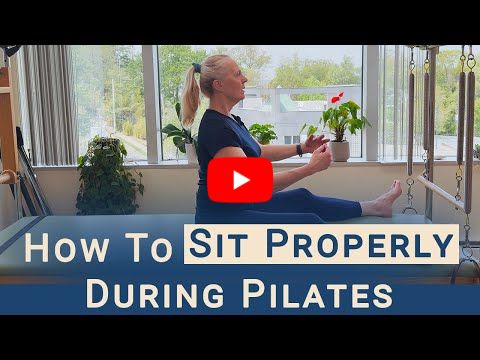
The position of the pelvis is one of the first aspects of body awareness I teach my clients. I hope someone introduced it to you early in your Pilates practice as well, because so much depends on it.
Your pelvis sits between your spine and your legs. Because of its central position, the way it's aligned influences what happens above it and below it.
That's true whether you are exercising, walking, standing, climbing stairs, or simply sitting.
That's why I encourage my clients to practice paying attention to it long before they set their eyes on more advanced exercises.
When the pelvis tips too far forward, the arch in the lower back often increases. The muscles of the lower back may end up doing more work than necessary, while the abdominal muscles contribute less support than they could.
When the pelvis tucks too far under, the natural curve of the lower back decreases. That changes how your trunk is supported and may leave the muscles working less efficiently.
Somewhere between those two extremes is where the muscles of your trunk are easier to access, to share the work of supporting your spine.
Your body doesn't automatically recognize the difference between what's familiar and what's efficient. It simply repeats what it has practiced. And that adds up.
If that's the case, it's time to teach your body a new movement habit and your mind a new definition of what feels "normal."
Because over time, sitting with the pelvis tipped too far forward can encourage a more pronounced arch in the lower back. The muscles of the lower back may begin working harder than they need to, while the abdominal muscles contribute less support than they could. Prolonged sitting in this position may also contribute to tight hip flexors, and hamstrings, and make it more difficult for the muscles supporting your trunk to share the work efficiently.
That's why I return to pelvic positioning so often when I'm teaching Pilates.
I also don't want it to become something you think about only during exercise.
I want it to become something you recognize while you sit, stand, walk, and move through everyday life.
So here's an activity for you to try today:
The next time you sit down—at your desk, in the car, or at the dinner table—pause for just a moment.
Don't worry about correcting anything yet.
Simply ask yourself:
How is my pelvis positioned right now?
You may not know the answer yet.
That's perfectly okay.
Every skill begins with learning what to notice.
But once you begin noticing a detail like this, you have the opportunity to improve movement habits that can influence how well your body serves you for years to come.
After all, your body doesn't have a "Pilates pelvis" and an "everyday pelvis."
It's the same pelvis supporting you all day long.:)

Responses