
A recent exchange on social media reminded me of something I have observed repeatedly over nearly three decades of teaching the Pilates method.
People often assume they understand an exercise because they recognize its name.
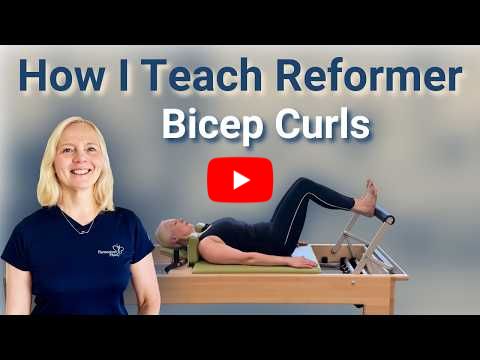
I recently shared a short video demonstrating what I referred to as Bicep Curls on the Reformer.
One person informed me that I clearly did not know what a bicep curl was because the movement looked more like a tricep press.
Another person became concerned because they had previously suffered a bicep tear and wondered whether this exercise would be appropriate for them.
Both responses were understandable.
And both missed the point.
In my teacher training, this exercise was called Bicep Curl because the movement of the arms resembles what most people recognize as a bicep curl exercise. Within the context of the Classical Pilates method, however, its purpose was never to isolate the biceps.
The choreography provides the task, but the task is to teach the skill of stabilizing the shoulder girdle while the arms move.
Can you organize the muscles of your trunk and shoulder girdle so that your shoulders remain broad, your neck relaxed, and your upper body steady while your arms perform a task?
That is the lesson.
In fact, this movement is often taught as preparation for Arm Circles on the Reformer. Before asking the shoulders to manage a larger, more demanding range of motion, we first establish control in a simpler movement pattern.
And this principle appears throughout the entire method. That's why many of the exercises are not what they first appear to be.
And that raises an interesting question:
If Pilates isn't simply teaching exercises, what exactly is it teaching?
|
To Your Health:)
Joanna

Responses