
This rather simple stick figure drawing remained on the whiteboard in my studio for more than three months.
It was the first whiteboard drawing I created.
I drew it to help my clients understand how the head, neck, upper and lower back should be organized when performing Swan and ALL other spinal extension exercises.
One stick figure showed the sequence I wanted my clients to practice. The other showed what I wanted them to avoid.
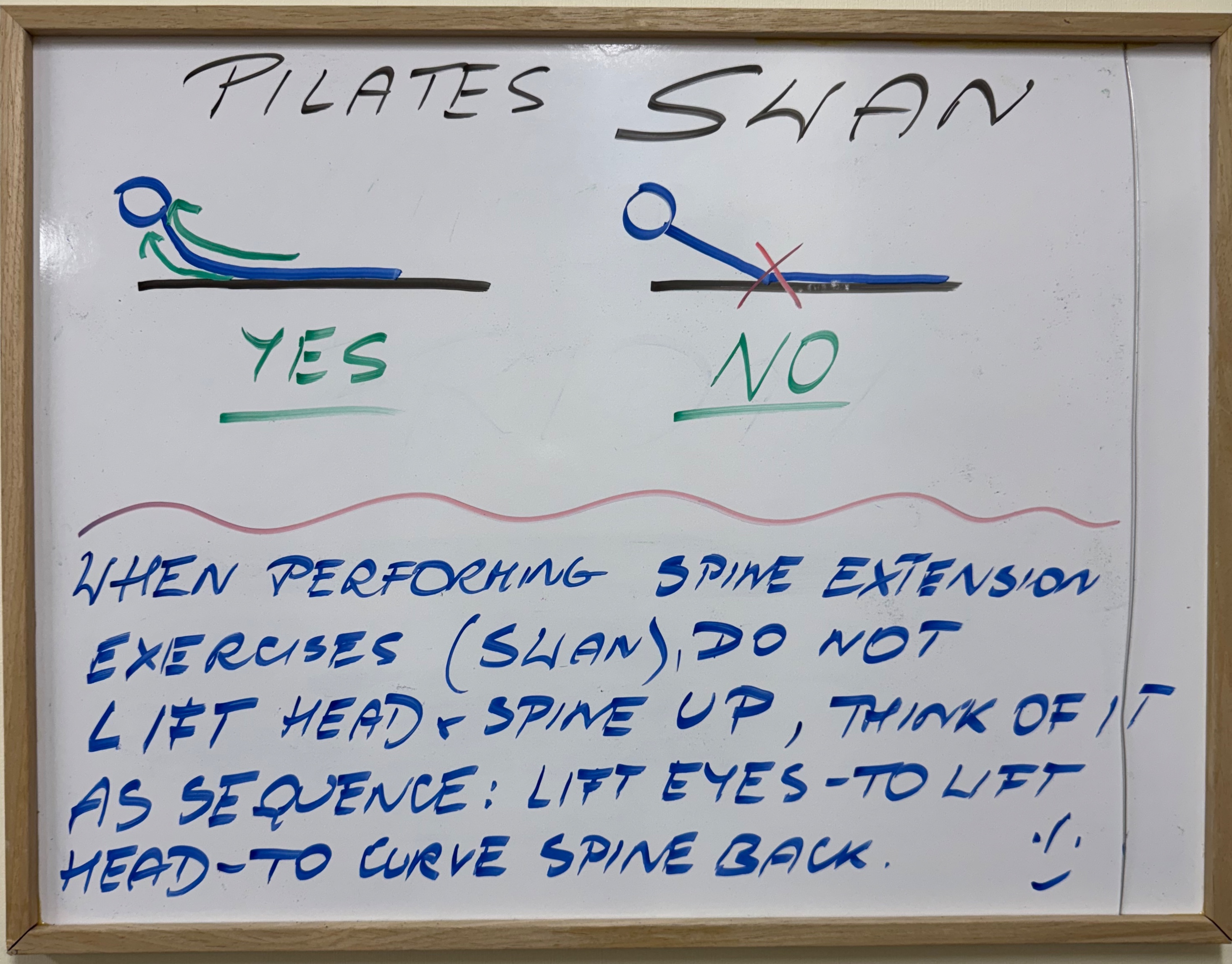
I thought the board would stay up for a short time, help me explain the idea, and I would replace it with an illustration of another concept/skill.
Instead, it remained there for more than three months, because it turned out to be a great teaching tool.:)
Back extension exercises continue to be one of the most challenging, intimidating and complex movements for those who practice Pilates.
One of the reasons is that most of us have relatively more mobility in the joints of the lower back and limited mobility in the upper back. When asked to perform a back extension exercise, we often resort to bending where movement is already easier, in the lower back. This can create compression and discomfort and, over time, lead to overuse of the lower back joints.
So as I encouraged my clients to look at the drawing, I would then mention the image to them any time they were performing Swan whether on the Mat, Reformer, Cadillac (Trapeze Table), or Chair. But I would also use this image when teaching them other spine extension exercises like Pull Straps, Down Stretch, or Rocking.
Little by little, they began to understand what I was asking them to do.
Since then the stick figure became a part of my teaching language, a way for me to communicate a correction and for my clients to understand it more clearly.
It also became a topic of conversations, like the proverbial discussions around the water cooler, where occasionally clients would “gather” around the whiteboard and exchange observations about what I drew on it.
Most importantly they would refer to it during their lessons.
I enjoyed watching this process.:) Using imagery is a part of teaching movement. Having an actual image to show and refer to during a lesson can greatly improve a client's experience.
Mission accomplished:)
The fact that the “How to perform Swan correctly” remained on the whiteboard for more than three months has amplified a very important aspect of how we learn to move our bodies.
Understanding a Correction Is Not the Same as “Owning it” .
You may understand the words the first time you hear them.
You may even perform the movement differently immediately after you get corrected.
But that does not necessarily mean you have learned it.
Learning requires you to recognize your familiar movement pattern, remember the new organization, and practice it often enough to find it again without depending on someone to correct you every time. That to me is “ownership”.
And that process cannot be rushed.
First, you need to become aware of the movement pattern you are repeating without realizing it. This can be difficult to recognize on your own. Often, someone needs to point it out and show you another way to move. One that will serve your body better.
After all, you cannot intentionally change a movement until you recognize what your body is doing.
And a simple drawing that shows the “don’t” and the “do” may be all you need.
Awareness does not immediately produce change, but it gives you a place to begin.
First, you notice, then you begin to understand, then you practice. And in this process, you often “forget the new way of movement and have to remember it” again and again, until the new way you are organizing your body becomes familiar.
I wrote about this aspect of Pilates in last week’s newsletter which you can go back to read here.
So awareness may begin the learning process, but repeated, thoughtful practice creates the progress you want.
Since creating that first Swan drawing, I have filled my whiteboard with many reminders about the pelvis, shoulders, spine, breathing, and the organization of movement.
Each drawing is intended to help my clients understand, or remember, something they are working on in their Pilates practice.
This week, I replaced the stick figures with a collection of words, which I hope you will find intriguing:
“Zip up.”
“Belt.”
“Vest.”
“Tape measure.”
These words belong to Kathy Grant. They are her famous “Song”.
Next week, I will show you my expression of the "song on the new whiteboard, explain the meaning behind these images, and explore what we can do with that awareness once we begin moving.
To Your Health!
Joanna
Keep Moving
-
You have to notice before you can change it.
Practice back extension with me on the Mat:
|

Keep Exploring
- Read my past newsletters for more Pilates goodness.
- When you are stretching , use these videos for better outcome.
Keep Learning
 |

Responses